A Direct Model for the PBL
Description of the Model
PBL-LIB is a collection of programs that employ the UW derived solutions for the surface layer and the planetary boundary layer flow patched together to yield a PBL model at a point.
It is unique in that it contains parameterization of the coherent structures, or Organized Large Eddies (OLE) (or just Rolls) from the nonlinear equilibrium PBL solution. This yields a modified Ekman solution containing OLE and therefore horizontal variation on the 1 - 5 km scale. These helical roll circulations provide more efficient mixing, yielding higher surface winds and fluxes than a conventional K-theory model. They explain why an Ekman/Taylor spiral is rarely observed, the observations of cloud streets, a highly variable Ekman layer turning at a point and the inadequate mixing in diffusion models (the OLE are basically an advective mixing in the mean flow).
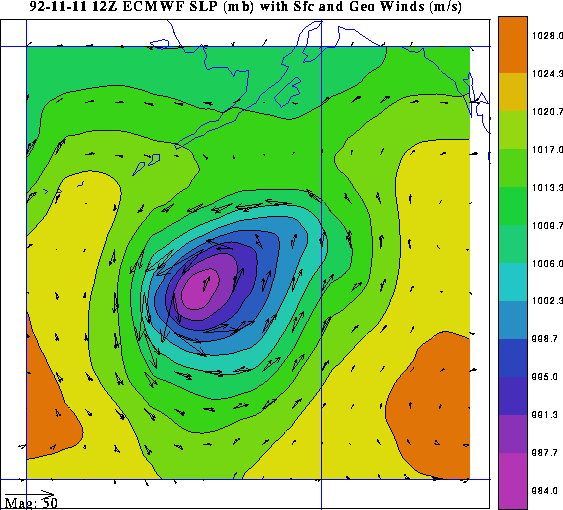
The program requires an input surface pressure field to provide a geostrophic flow boundary condition from which the mean PBL velocity profile is found. This is the wind averaged over several OLE and would be observed only in a 50 - 100 km horizontal average. Alternately, a one hour average at a point would see several rolls drift by at about 1 - 3 m/s in neutral stratification. However, observations indicate that frequently temperature stratification (convection) has a significant effect.
When air-sea temperature difference is input, the convective energy
is included in the instability and the characteristics of the nonlinear
equilibrium solution containing OLE. The result for unstable stratification
yields nearly zero drift. Thus, even a long time measurement at a point will be nonrepresentative of a horizontal average.
There will be variable turning and surface wind magnitudes depending on
whether one is in the convergent/updraft or divergent/downdraft region
of the rolls. For more information and sketches see texts on RA
Brown's homepage.
Robert A. Brown
When horizontal air temperature is input, the thermal wind correction can be accounted for --- both in the instability (Ralph Foster thesis) and the finite perturbation.
In all cases, humidity or dewpoint can be input to account for potential temperature effects.
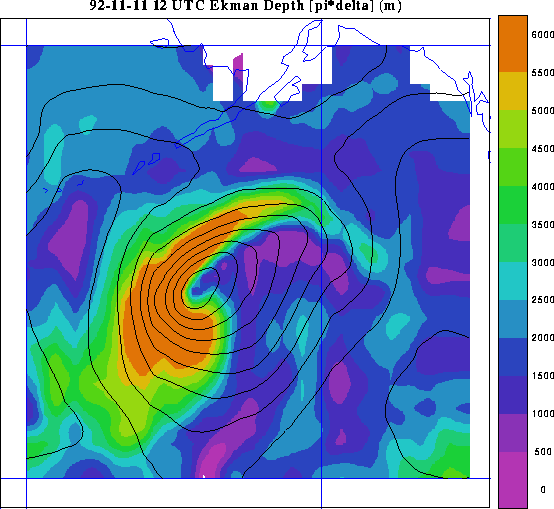
To Run: Give the program BWIND four (or at least one; the pressure field) geophysical parameters, and it can calculate a whole host of other parameters, including:
- Surface wind speed (U10) and cross-isobar turning angle (a)
- Surface stress (u*)
- Fluxes of sensible and latent heat
- Thermal wind in the PBL
- Ekman depth (p d) (d=sqrt[2K/f] where K is eddy diffusivity for small eddies only). f is the Coriolis parameter.
- Roughness length over water (zo)
- Stratification parameter z/L (related to air-sea temperature difference)
- Surface Geostrophic wind
- Geostrophic wind